Off-Course 90% of the Time
Most leaders treat performance like a straight line. You set a destination, fire the engines, and assume any departure from the flight plan is a sign of poor execution.
When they drift off course, they panic. They either double down with reckless effort or throw their hands up in frustration.
Planners call this a failure of execution. Elite operators call it Tuesday.
Great leadership doesn't happen by maintaining a flawless trajectory. It happens in the narrow corridor of continuous mid-course correction where high standards meet internal peace.
The Apollo 11 Mid-Course Correction
When Neil Armstrong, Buzz Aldrin, and Michael Collins flew 240,000 miles to the moon, the popular narrative was that NASA aimed the rocket and flew in a straight line to the target.
In reality, the spacecraft was technically off course for more than 90% of the journey.
The mission succeeded not because the trajectory was perfect, but because the crew performed continuous mid-course corrections. Tiny, deliberate micro-thruster burns kept the ship locked inside a narrow gravitational corridor between Earth's pull and the Moon's orbit. Over-correct with too much thrust, and you shoot out into the vacuum of deep space. Under-correct, and Earth's gravity pulls you back down into the atmosphere.
Flourishing leadership works the exact same way. You aren't aiming for a static destination; you are navigating a high-stakes flight path through constant calibration.
Control Theory & The PID Loop
In systems engineering, this exact mechanism is governed by Control Theory through what is known as a PID Loop (Proportional-Integral-Derivative Controller).
Engineers use PID loops to stabilize complex machinery from a spacecraft to automated manufacturing plants. The loop constantly measures the "error gap" between current performance and the target setpoint, adjusting energy output in real-time.
When a controller is mis-calibrated, the system breaks in one of two ways:
Gain Instability (Burnout): The controller overreacts to every minor gap, causing the system to oscillate wildly back and forth until the hardware destroys itself.
Sluggish Drift (Complacency): The controller under-reacts, falling far behind its operational setpoint and settling into permanent error.
This is the mechanical reality of human performance.
Hustle culture creates “gain instability” overreacting to every gap until you burn out.
Complacency creates “sluggish drift” failing to measure the gap until you become irrelevant.
Living in The Intersection
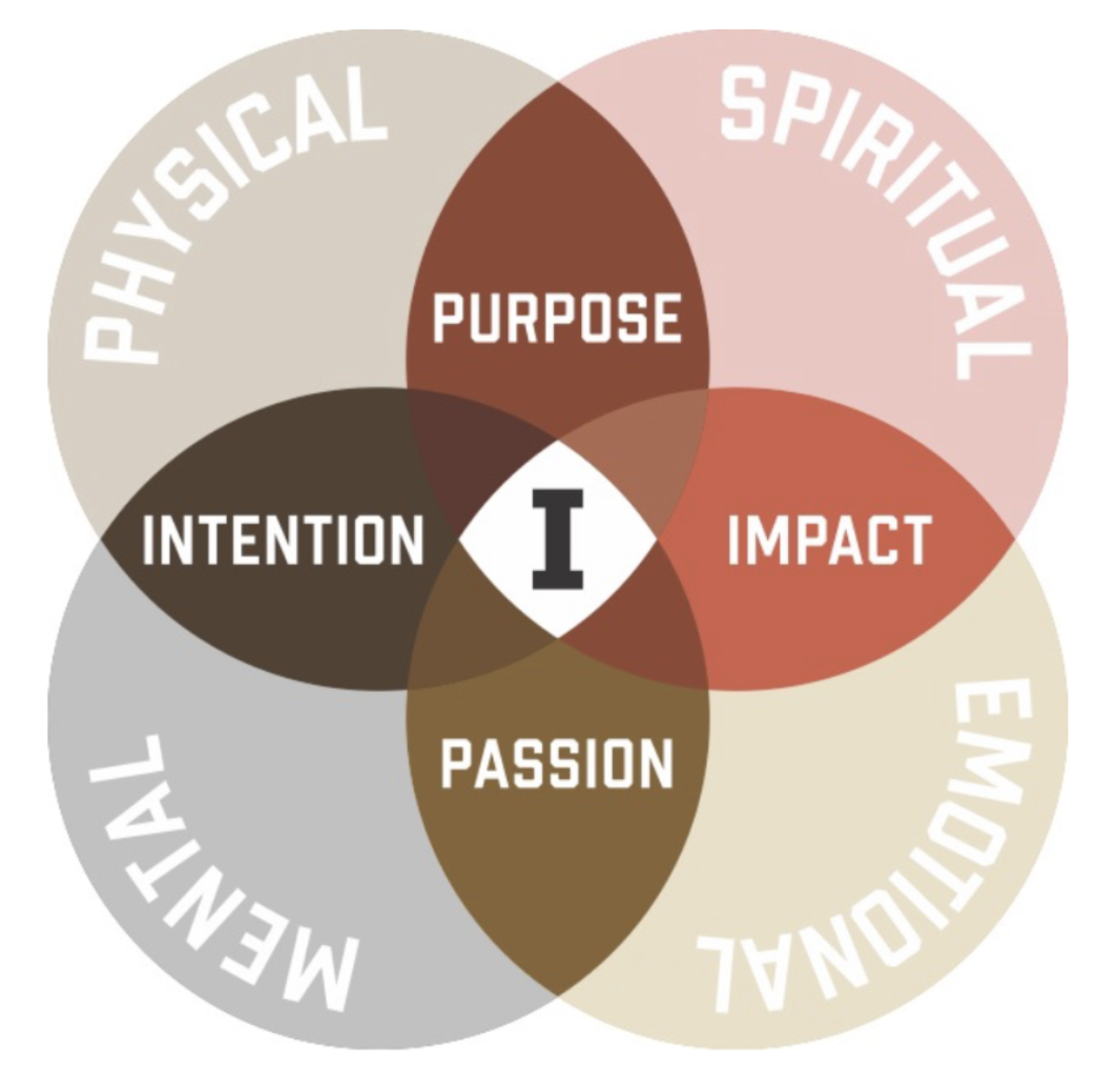
Living in The Intersection means operating like a human PID loop. It is a mindset for everyday leadership that replaces chaotic effort with precise micro-adjustments across two distinct axes:
Internal Calibration: Syncing your daily passions with your core purpose. (Are your internal engines firing toward what actually matters?)
External Calibration: Syncing your purest intentions with your actual impact. (Is your hard work producing impactful results, or are you just making noise?)
This ongoing calibration is how you create harmony between effort and ease, training and recovery, ambition and humility. It keeps you in the sweet spot where capability expands without breaking the engine.
The Feedback Sensor
Here is the catch: You cannot calibrate a closed system from the inside.
In control theory, a PID loop requires an external sensor to feed real-time data back to the controller. In leadership, that sensor is Reflective Appraisal.
There are structural blind spots in your game that even the highest level of self-awareness cannot spot. You can only see them through the mirror of high-caliber relationships. Coaches, mentors, peers, and teammates who care enough to give you genuine feedback.
Every honest interaction feeds data back into your system, refining your mindset and building authentic self-belief.
You don't flourish by accident, and you don't sustain peak performance by brute force. You achieve it by staying in the calibration zone, listening to the data, and embracing life in the intersection.