
Do You Have the Courage to Rest?
What does it look like when you’re at your best?
It is a great offseason exercise to reflect and consider what you at your best looks like. It’s an even better in season exercise to re-orient yourself back to your best when it matters most.
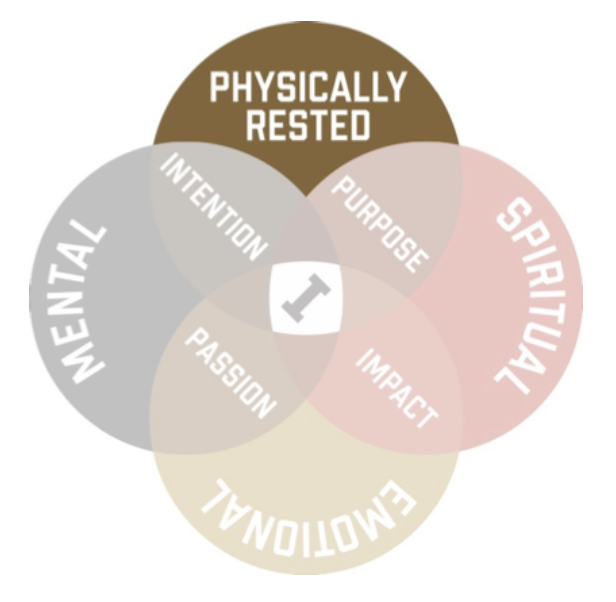
A few weeks ago I shared some perspectives on what it looks like to flourish mentally. It is an equally important topic to consider what it looks like to flourish physically. Both the mental and the physical have profound impacts on you at your best.
Is flourishing physically simply about body physique? How much weight you can lift? Your mile time? VO2 Max? Looking strong at the beach?
Or is it much deeper than that?
Ultimately if we’re going to flourish, we’ve got to understand that to flourish physically isn’t just about vanity fitness metrics, it is to be physically rested.
High performance is not what you can do, it is what you can recover from.
The Modern Attack on Rest
Rest is not a popular term in high stakes environments.
Yet one of the best markers of physical health is a low resting heart rate. Why? Because it speaks of what full capacity is when it’s available.
Rich Froning, won four consecutive Crossfit world championships and was at one point deemed “The fittest man on earth.” At his peak, he reportedly had a resting heart rate of 26 beats per minute.
Ryan Hall, the most decorated United States distance runner in history, reported a similar sentiment of a resting heart rate of 26 beats per minute during peak fitness.
Being physically rested is a big deal.
But most of the time, high performers I work with admit it’s hard for them to rest. There’s constant pressure, never ending demand, a full calendar that needs to be full to steward the job well.
Recently, Shohei Ohtani, the best baseball player in the world (possibly to ever live) revealed his “less is more” approach saying “It takes courage to rest.”
Being physically rested is a big deal, but developing the courage to rest is probably a bigger deal.
We’re not relating well to the term “rest” in positions of leadership.
Athletes fully understand the need for rest, but in our professional work lives, rest becomes an afterthought at best, and something we pride ourselves in avoiding as our culture is “addicted to the grind.”
Our Misunderstanding of Rest in Leadership
Part of the reason why I don’t think we’re relating to the word rest is because there’s multiple definitions for the word and some are utterly unacceptable in high performance environments when there’s high expectations on your role.
Consider these definitions of rest. (Screenshots straight from Webster’s dictionary).
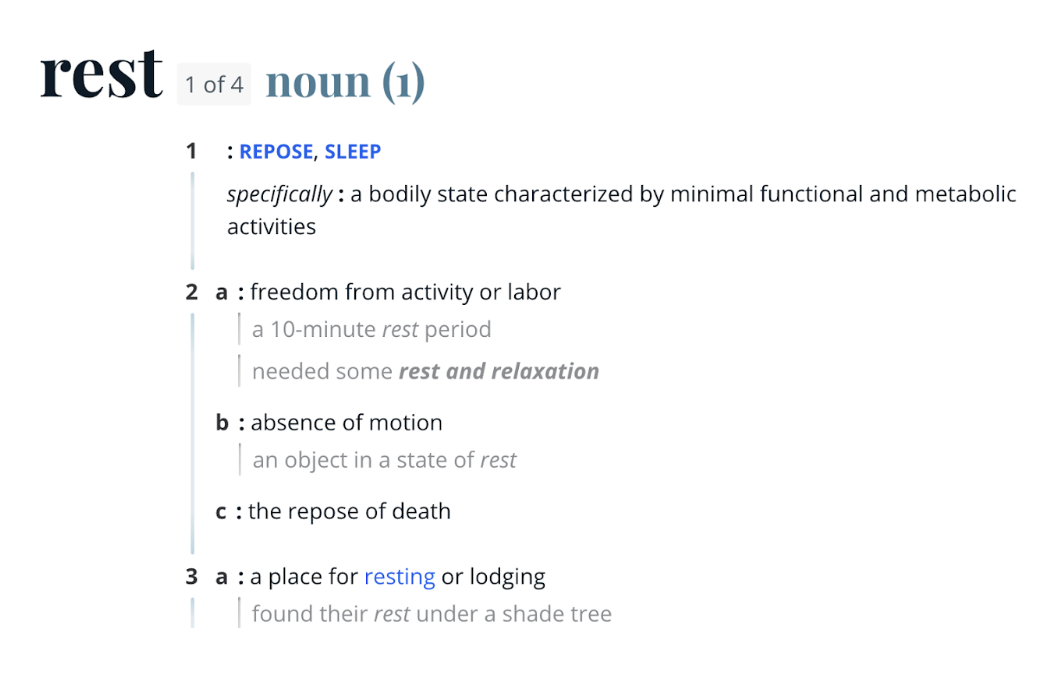
If we’re all honest, these simply will not work.
“Freedom from labor”, “Minimal function.” “Absence of motion.” “Resting under a shade tree.”
When you’re on the door step of real achievement and the pressure is mounting, this version of “rest” feels not only reckless and irresponsible but downright foolish.
We’ve got to go get it. We’ve got to pound the stone. We can’t be idle when pressure is mounting. So it becomes very easy to give way to our desires and get out of whack.
“I’ll rest when I’m dead.”
Or exist in a life rhythm where the only form of rest is the planned family vacation 5 days out of the year.
Meanwhile we’re sliding down the Human Function Curve, exhausted, and our actual performance is far less than our best.
There’s another way to relate to the term rest though. One in which there are profound mental, emotional and spiritual benefits. There’s a fourth definition to the term rest. Peace of mind.
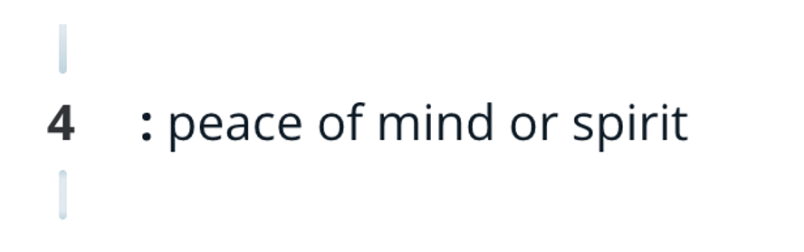
When we begin to orient ourselves, our physical health, our pursuit of peak performance around this understanding of rest, we can begin to see the encouragement to truly REST along the way has been hiding in plain sight.
Why True Rest is a Legal Performance Enhancing Drug
Stress comes in multiple forms. When our mind is anxious our body feels it.
Overthinking, overanalyzing, mentally straining - drains our physical energy.
Lack of sleep, physical fatigue, physical tightness/anxiousness - depletes mental focus.
Our mind’s capacity to handle stress impacts our body’s capacity to handle stress.
You can take two people who are experiencing the same circumstances, stress and strain.
One person is operating out of a lack of peace of mind and the other person with the same stress, strain, and demands is operating with peace of mind - the physical restedness in the body will be profoundly different between each person.
Peace of mind allows the body to rest.
This is not about “avoiding stress” or denying the impact of high stakes environments, it is about taking a whole person view of high performance.
Moving about, working hard, operating in life and leadership with a profound sense of “peace of mind or spirit.” Is a legal performance enhancing drug.
John Wooden, arguably the greatest coach who ever lived seemed to hint at this idea when asked how he defined success. He said:
“Success is the peace of mind, which is the direct result of self-satisfaction in knowing you made the maximum effort to become the best of which you are capable of.”
Line up 100 leaders in today’s day and age across multiple industries. 99 are “addicted to the grind.” And 1 is operating from an internal “peace of mind” rooted in a well cultivated ability to rest. I’ll bet on the 1 to be the most effective day in and day out.
How Does a Leader Cultivate Personal Rest?
First it takes courage. It is not passive. It takes going well against the grain of our culture.
Second it takes properly defining what rest is and isn’t. Rest is not apathy, vegging out, or a mindless scroll of social media when the kids are finally in bed.
It is a peace of mind that is a direct byproduct of a series of mental, emotional, physical and spiritual rhythms and disciplines.
I’ve found that the idea of rest is so foreign to leaders and high performers in the arena that a great starting place is the following exercise:
Get out a piece of paper or a clean sheet in your journal.
Create two lists.
Title one list - “Things that help me rest.”
1.
2.
3.
4.
5.
Title the other list - “Things that keep me from resting.”
1.
2.
3.
4.
5.
Awareness is often the lead domino.
What is keeping you from resting?
What helps you rest?
How can we purposefully address the things that keep us from resting? (Eliminating, Confronting, Releasing, Accepting).
How can we purposefully engage with the simple things that help us rest? (A good cup of coffee, a good workout, time in nature, sauna/cold plunge, a phone call with a great friend, an intentionally crafted week, a focused four hour block)
This exercise isn’t going to solve chronic unrest. But it can begin the process of purposefully working toward flourishing physically.
Your life and leadership are more effective when you are physically rested.
Do you have the courage to rest?
Stay The Course,

