The Rule of Thirds
I was working with a top college baseball pitcher the other day when he expressed discouragement and frustration with how he has been feeling lately.
He’s put in significant work, and has seen his fastball velocity rise over the last two years, but on this particular day, his fastball velocity had dipped and was less than he hoped.
It created an emotional reaction in which he began to spiral into a larger, fear-based doubt of all of the training up to this point.
It’s a common experience if you’ve ever gone through long training blocks of day in and day out work.
Some days you leave and feel horrible. You begin to doubt and get frustrated with a lack of progress. Other days you feel fresh, renewed and great. You can begin to get a positive delusion on your true capabilities.
How can an athlete or leader develop the ability to not be “easily bothered” by micro data points in a larger data set?
The answer comes with raising our level of self-awareness. Learning to recognize our emotional reactions to individual experiences while maintaining perspective on how those experiences fit within a larger process or system.
Olympian Alexi Pappas shared a story once from when she was building up for the 2016 Rio Olympics. In a particular track workout she failed to hit her splits, sending her into a mixture of discouragement and panic with little time left to sharpen for the Olympic Games.
Her coach, Ian Dobson, stepped in with some much-needed perspective. While Pappas was allowing one training day to undermine her confidence in a larger process, Dobson introduced her to the Rule of Thirds.
In the Rule of Thirds, there’s room for days when you don’t feel like your output is at the level you need it to be. In fact, the Rule of Thirds suggests that perhaps it’s supposed to be that way.
The Rule of Thirds
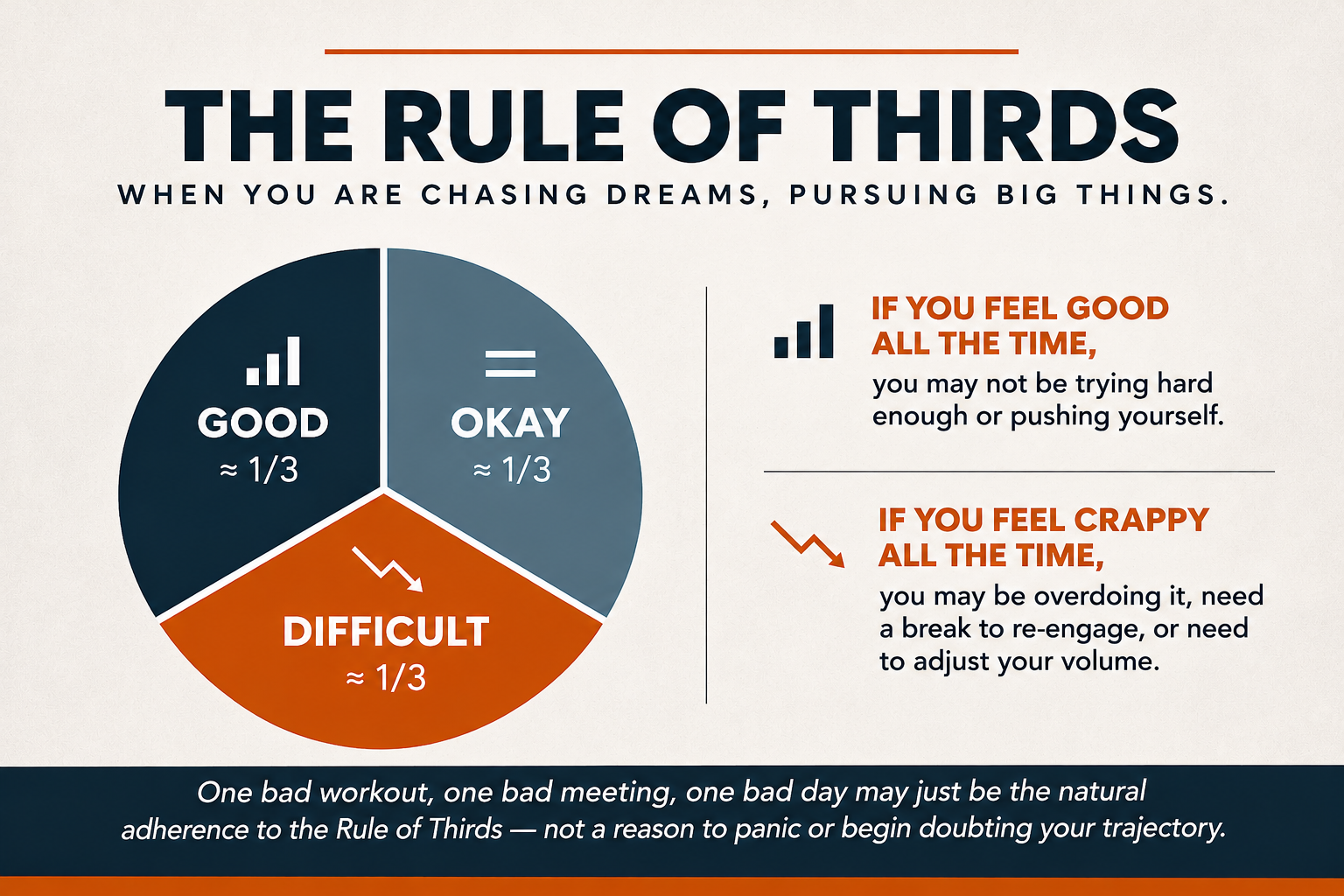
When you’re chasing a dream or anything difficult, you are meant to feel “good” a third of the time, “okay” a third of the time, and “crappy” a third of the time.
If you feel too good all the time, you may not be trying hard enough or pushing yourself.
If you feel crappy all the time, you may be overdoing it, need a break to re-engage, or need to adjust your volume.
“One bad workout, one bad bullpen, one bad day” may just be the natural adherence to the Rule of Thirds - not a reason to panic or begin doubting your trajectory.
How can this become an actionable framework for leaders and performers?
Begin by developing a more objective, non-judgmental view of your daily experiences.
Identify a few important areas of your leadership or performance and begin tracking how you feel and perform in those areas. Categorize your days as good, okay, or difficult.
Over time, begin looking for patterns and trends.
Are you experiencing a healthy mixture of good and difficult days? Are you consistently feeling worn down? Are you making progress even when individual days don’t feel like they’re productive?
The goal isn’t to make every day feel like a good day. The goal is to develop enough perspective to accurately assess your progress without allowing the emotions of a single day to determine your confidence in a larger process or system.
Stay The Course,
JB