

Your Goals Might Be The Thing Holding You Back
Here’s a Tuesday morning hot take for you - “Goals” are a distraction and often cause more harm in the mind of a performer than they do good.
Stick with me before you unsubscribe.
I have the privilege of spending a lot of time with elite athletes, coaches and teams working to build sustainable performance systems for when it matters most.
And in the hundreds of hours I’ve logged “on the job site” in 2026 I am becoming increasingly more convinced that goals in the traditional sense cause more harm than good.
“I want to be conference pitcher of the year.”
“I want to run a personal best of 17:25 and break the school record.”
“I want to earn an NCAA Division I scholarship.”
“I want my team to win the conference championship.”
These are the traditional goal structures we work off of and often frame our default approach to achievement.
You could be reading this and be thinking “What’s wrong with goals like this?!”
Here’s my concise perspective on what’s wrong with these - (reach out for a deeper conversation.)
They’re out of your control.
There’s no mention of who you’re becoming - the personal qualities that the pursuit actually develops.
They will inevitably require things to go perfectly - they don’t account for the randomness of life in the arena.
When we fixate on a goal we don’t realize we are building a prison of our own making for our mindset, identity, and expectations.
1.) They’re out of your control:
One of my favorite exercises I do with clients is The Control Box. Take out a sheet of paper and create a rectangle in the middle. Begin to think of all of the components of your life in high performance. If it is something you can control - write it in the inner rectangle. If it is something out of your control (the weather, umpires, teammates, parents, fans, etc.)
Here is an example of a control box I did with a college baseball player in the SEC.
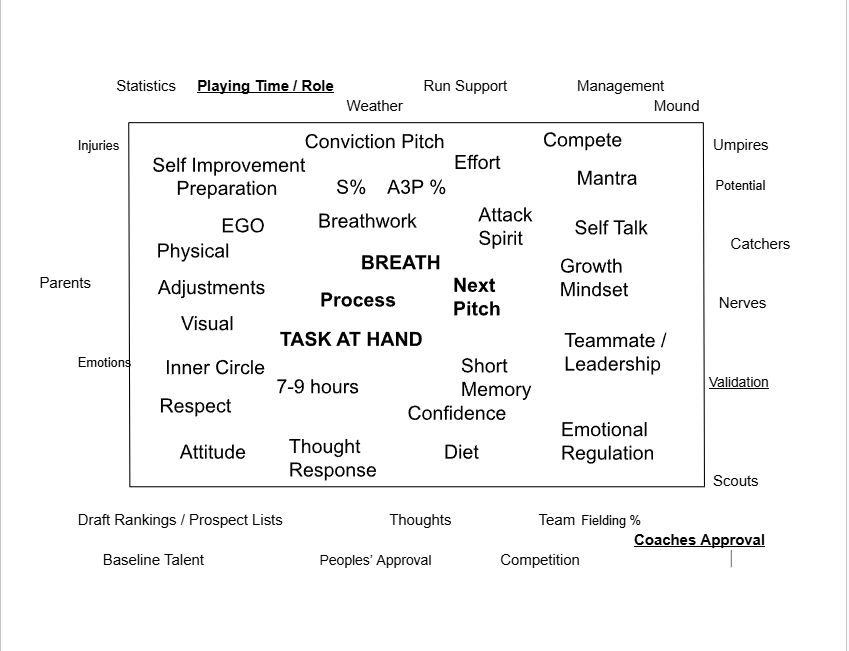
If you were fully committed to all of the things in the box would you like where that would trend for your career?
Where does the majority of your attention go - things outside of the box or in the box? (Most performers admit to me that the most consuming things for them are often on the outside of the box - we’re human.)
You can write down your goal everyday. You can stick it on your mirror, your steering wheel, whatever.
The greatest predictor of your future success is not what you write down as a goal on a 3x5 notecard, it is the level of true commitment you have to the things within your control.
Most goals aren’t in your control. Most commitments are within your control.
Your commitments say more about you than your goals do. (And your commitments when stacked probably will lead to the goals anyway.)
2.) There’s no mention of who you’re becoming
I have yet to come across a person whose New Year's resolution is to become a more resilient, antifragile individual. I haven’t found any achievement-oriented individuals who create goals based on the type of person they are becoming. Instead, we’re settling for random goals like weight loss, projects, a couple races here and there, books read, etc.
When we fixate on an achievement goal we miss the plot. The achievement isn’t what transforms you. Standing on top of the podium is a 4 minute experience. The early mornings in the pursuit is where you get renewed.
Who you’re becoming is far more important than what you’re achieving. If we believe this to be true, what would it look like to reframe everything about the pursuit?
If the goal is defined as “My goal is to be an All-American this year.” Then every outing becomes a threat to my statistical resume needed to become an All-American this year.
If the goal is instead defined as, “I want to become the best in the world at bouncing back from poor outcomes.” Then every poor outcome becomes the training ground to develop the mental, emotional and spiritual discipline needed to bounce back.
3.) They will inevitably require things to go perfectly
Fragile mindset = "I hope everything goes smoothly today."
Antifragile mindset = "Whatever happens today, I'm poised and prepared to work through it fully engaged and fully committed."
At the Beijing Olympics in 2008 Michael Phelps executed a "perfect" Olympic Games.
8 events. 8 Gold Medals.
Yet what was most impressive is not that he swam "perfectly" it was his ability to handle imperfect conditions and still execute at the highest level.
In the 200M Butterfly final his goggles filled with water early in the race. By the time he turned for his last lap, he was swimming completely blind.
"I couldn't see anything. I just counted my strokes and hoped I got it right." Phelps said.
The best leaders aren't looking for perfect conditions. They've intentionally trained what to do when things go wrong. Phelps and his legendary coach Bob Bowman prepared for things like this long before stepping onto the starting blocks of an Olympic Final.
In the lead up to the Olympic Games, Bowman intentionally broke Phelps' goggles so that he would know what it was like to swim with water in them. In another key workout, Bowman randomly turned the lights off so Phelps would swim in the dark and train the ability to count strokes from one end of the pool to the other.
Phelps described Bowman's training methods as "He would arrange whatever he could think of around being uncomfortable in training."
As the saying goes "You don't rise to the occasion… you fall to the level of your training."
Goals - especially outcome oriented ones have little to do with elevating your training. Aside from an initial boost in motivation - which inevitably wanes as time goes on, they have little utility in developing your performance system.
If they don’t develop your performance system and they lead to discouragement and fragility when dealing with inevitable adversity (playing time, injuries, etc) then why do we do them?
I’ve come to believe that immature performers and leaders view goals as toddlers view pacifiers.
They are soothing devices to comfort us. For performers they comfort us when we’re faced with the inevitable monotony of high performance. They soothe our egos and don’t allow us to fully develop our identity away from achievement.
When my two older sons were younger, we had to wean them off of their pacifiers. We would limit them to only using the pacifier at bedtime. We eventually cut them in half and allowed them to hold them in their pocket. Eventually they let go of it altogether and in doing so were more free to face the world of opportunity and possible danger.
When outcome orientation dominates (goals) fear has a tendency to rise when the chips are down.
When process orientation dominates (commitments) courage has a tendency to rise when the chips are down.
What would it look like for you to release the pacifier of traditional goal lists and double down on your commitment list?
Your commitments say more about you than your goals do.
Stay The Course,
