

The Film Doesn't Lie: What Your Default Reveals Under Pressure
It’s summer time and our family spends a lot of time at the pool. Our oldest, who is about to turn 8 is in the middle of a significant challenge that is testing all his physical, mental, emotional, and spiritual limits.
He’s staring down the diving board.
Maybe you can remember when you conquered the diving board, but this challenge has been bullying our son, Judah all summer.
Every trip to the pool becomes the possible day he will conquer the diving board, only to create a tangled experience of desire + doubt + belief + overthinking + stress.
The challenge is before him.
Climb up about four feet onto the diving board.
Walk the plank.
Jump into the deep end (12 ft deep), swim unassisted roughly 8 meters to the side pool ladder.
Climb out to the roar of a supportive crowd (My wife, myself and his two brothers).
Like most significant challenges and transitions in life - those who know us best are watching from the sidelines and can tell once this move is made, everything will change.
My wife and I are simultaneously rooting for him and challenging him to work up the courage to jump off this diving board, not because we think he’s going to the Olympics someday in diving, but because as soon as he goes off this board for the first time - he’s got the rest of the summer to fully engage with the joy, excitement, and fun that comes with the diving board.
We know this is the best move for him. We know that he is capable and ready. We also know there is so much value in expanding comfort zones, facing fears, and taking action when you’re afraid.
But he’s stuck.
Understandably so, his mind under stress is thinking of all the things that could go wrong. How deep the water is. How far away the side of the pool is. How no one is allowed to be in the water to catch him (per pool rules of course). How he has to do it all alone.
Because of stress, fear, strain all of the logical facts of the case get thrown out the window. Our mind fixates on variables and data overemphasizing probabilities and scales to play worst case scenarios in our minds eye.
“But it’s twelve feet deep!”
It can be 100ft deep, who cares, he knows how to swim.
“The ladder is so far away!”
He’s swum 30 meters unassisted before. Three times the distance this task will require.
“But I have to be in the water all alone! What if I drown?”
The lifeguard (a trained professional) is right there. I’m also standing right on the edge of the pool ready to jump in and help.
The Relationship Between Thinking and Action
Here’s the thing that has been interesting and something I’ve noticed not just with 8 year old aspiring divers, but with top athletes from HS to the SEC, coaches across all levels of college athletics and many business leaders I have the chance to work with - good decision making requires a healthy balance between thinking and acting.
If we don’t think things through, we might step off the plank right into danger. However once we’ve gathered all the facts we eventually just need to make a move and get going.
I’ve met and worked with top performers who are heavy action takers. They jump first and figure it out as they hit the bottom. They can be reactive, quick on their feet, and do not need to see the full field before making a decision. They simply GO - then respond.
But the downside is they can get themselves into trouble with all that action. They make mistakes that take months to repair. They can chase ambitions only to get to the end and realize they never really wanted what they chased. They can become very unclear about what their true desires are for their life, performance, and leadership.
I’ve also worked with really elite performers who are deep thinkers. Their mind is always running and synthesizing inputs. They are deep processors, and often come up with profound insights for their own journey or other peoples’ journeys. They see the full field of play, often point out things other people miss, and can move about with a level of clarity that was born out of deep introspection.
But they can also overthink. They can ruminate and loop the same patterns. They will repeat themselves over and over detailing the same data, same details, and same uncertainty. They can abdicate the need for action by thinking more. They can pacify themselves with more thinking when it’s all been thought out - it’s just time to jump.
The Film Doesn’t Lie
ESPN Basketball commentator, Jimmy Dykes wrote a great book titled, The Film Doesn’t Lie. The premise is based on the metaphor from sports about a coach’s film session. In a film session, you replay the tape from the game and watch what happened. You watch for tendencies. You watch for habits - good or bad. You use the film to guide your practice plans and identify what needs worked on.
What would the film say about your relationship with thinking or action?
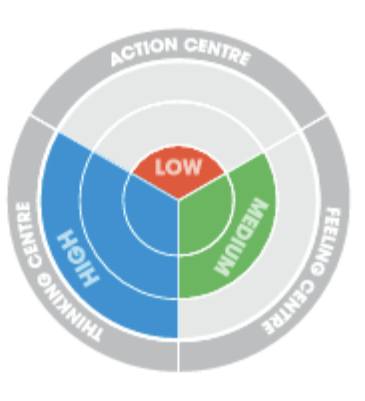
You don’t have to guess. One of my favorite tools I use in coaching with high performing athletes, coaches and leaders is the IE9 Enneagram Assessment. And in this assessment is a rundown on what is called your “Centers of Expression.” We all have three Centers of Expression, Thinking, Feeling, and Action. We all have a dominant Center of Expression and a weakest Center of Expression.
Your dominant Center of Expression shapes the way you interact with others and how you approach challenges. When confronted with an unusual challenge or surprising situation, your dominant Center of Expression will be your default. Your growth comes in learning to use all three Centers in a healthy way. This comes through active coaching and practice, not by accident or on its own.
These tendencies are showing up in how you live, perform, and lead without you realizing it or not. Those closest to you have a great sense for where your Center of Expression is (The film doesn’t lie).
I know my son Judah really well. As we discussed his diving board dilemma we came to a halt the other day. I communicated some sense of “You’re never going to feel ready to jump off this board. At some point, we’ve got to stop thinking and just move. You need your hands and your feet right now more than your head and your heart.”
I also know this Thinking Center of Expression really well. The advantages and the shadow sides. The image of the expressions above isn’t of Judah’s - it’s mine. Heavy thinking center. Low action center.
The heavy thinking has added great value to my life and others. I’ve written books, articles, podcasts overflowing from my thoughts. It’s helped clients all over the country.
But it’s also jammed up a lot. It has produced overthinking, second guessing, and hesitancy when I needed to take action. Relational silence or distance when I needed to speak up. Drift away when I needed more presence.
Having worked with many high performers who read this newsletter, I have a suspicion, somewhere in your life, you’re staring at a diving board.
Maybe it’s a conversation you’ve been avoiding. A decision you’ve delayed. A business you’ve wanted to start. A boundary you needed to set. A step of obedience you’ve explained away.
Or maybe you’re the opposite. You’ve spent your life jumping off boards, making things happen, but rarely do you slow down long enough to ask if you’re headed where you want to go.
There is no singular “correct” Center of Expression. The goal isn’t to become less of a thinker or less of an action taker. The goal is to know your default tendencies when you’re under stress so you can respond toward the best possible outcomes.
Every new challenge reveals the way we’re wired.
The next chapter of Judah’s summer begins the moment he jumps off that board.
I have a feeling the next chapter of your life, leadership and performance will begin the same way.
If you’d like to learn more about your Centers of Expression and how they are impacting your performance - check out The Overflow.
When the timing is right for you - I’m here to help.
Stay The Course,
