How Things Get Done (Well)
For as long as I can remember, I have been fascinated by how things are accomplished.
Growing up, I would binge-watch shows like How It’s Made or Sports Science. Whether it was a jaw-dropping feat of elite athleticism or a mind-bending industrial manufacturing process, I always wanted to pull back the curtain on the how.
Over the years, studying performance at the highest levels, I’ve come to a definitive conclusion: The answer to any "how" always lies in a framework.
Frameworks are the invisible architecture that gives shape to the processes leading to our desired outcomes. And here is the fascinating thing about them: They impose their influence regardless of whether you are aware of their existence or not.
This reality creates a massive divergence in execution:
The Novice Trap: The novice operates on max effort. They become increasingly frustrated when consistent hustle fails to produce consistent results, not realizing they are routinely skipping critical steps in a proven sequence. No amount of amplified effort can overcome a structural gap.
The Master's Edge: The master consistently achieves excellent results with seemingly minimal effort. They don't necessarily work harder; they have a deeper understanding of the existing framework, allowing them to extract maximum leverage from every action.
Mastery loves simplicity. Ego loves complexity.
As leaders, we are constantly trying to navigate the gap between Point A and Point B—from our current state to our desired future state.
When execution stalls, the ego wants to add more meetings, more metrics, and more complexity.
Mastery simply looks for the missing piece in the framework.
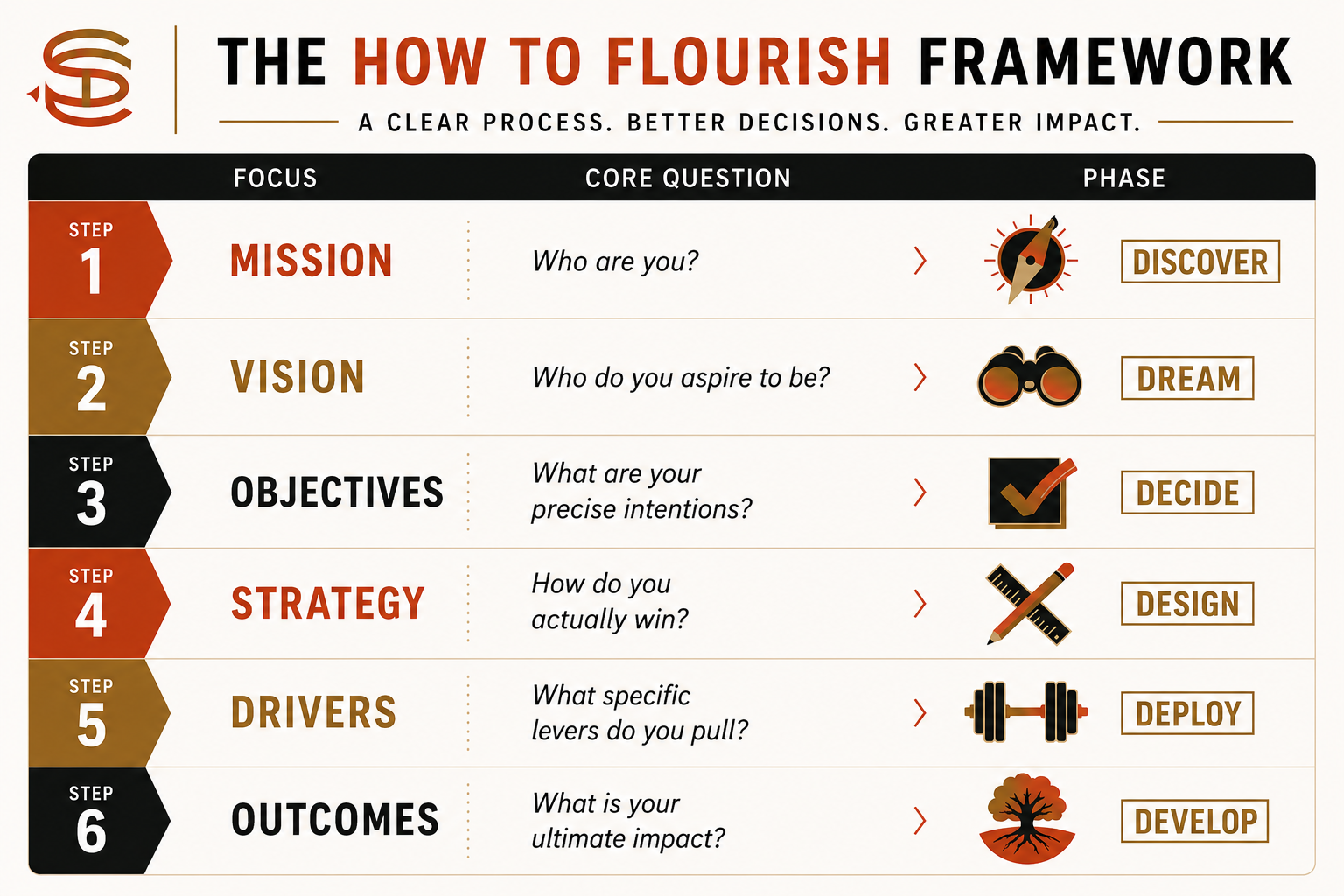
To help you audit your own execution, I want to remind you of the foundational blueprint we use: The How to Flourish Framework.
Below is the most streamlined version of this framework. Use it as a diagnostic tool to see exactly where the gaps might live in your current personal or professional initiatives:
When a project fails or momentum stalls, it is rarely a symptom of a poor work ethic or lack of competency.
More often than not, you've tried to Design a strategy without truly Defining the objective, or you've Deployed daily tasks that don't align with the overarching Dream.
Brute force will only get you so far.
Look at your biggest strategic priority right now. Which step in the framework are you accidentally trying to skip?